
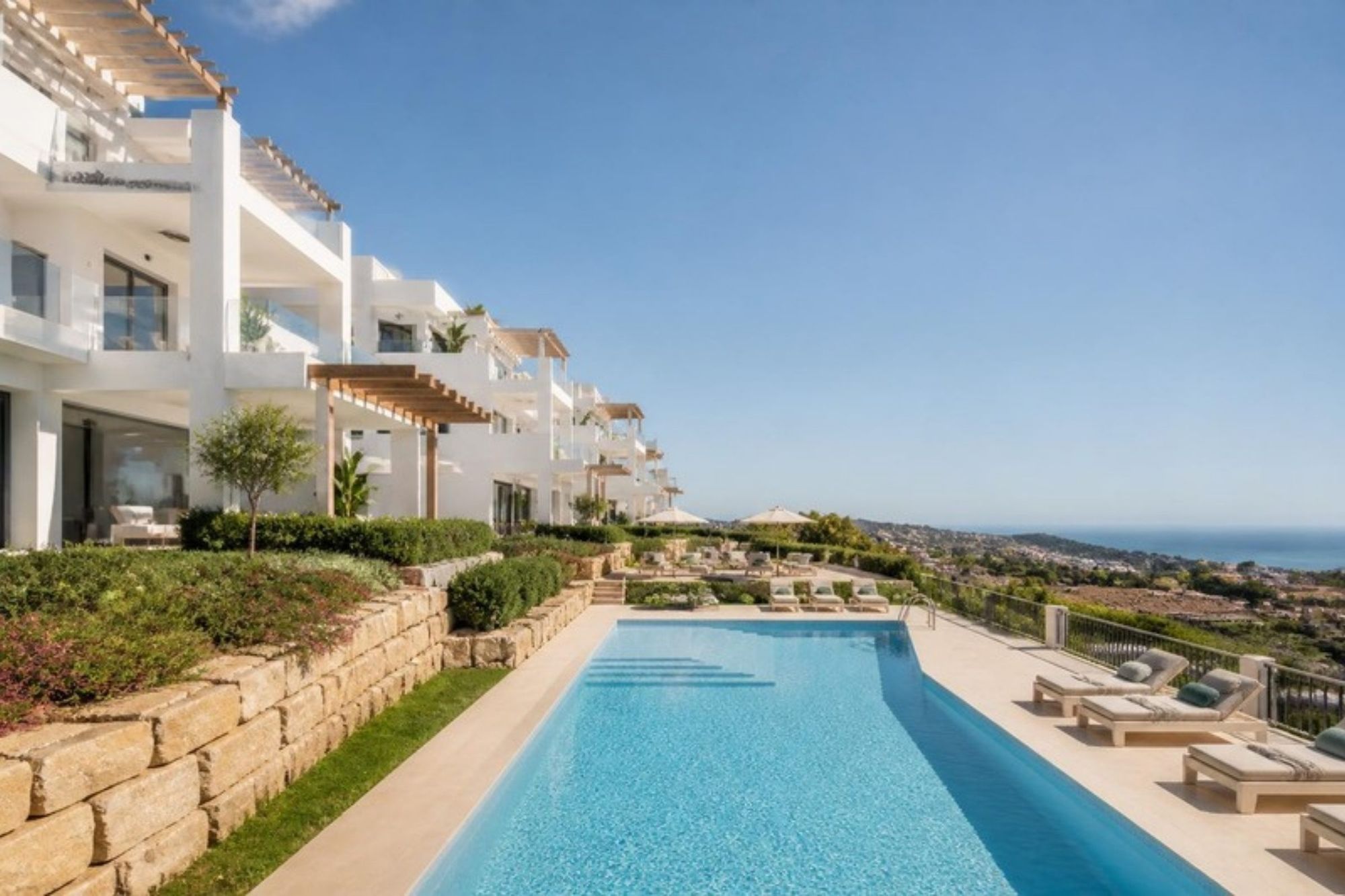
From Estepona to East Marbella and Mijas Costa, a great many new complexes have been built in recent years. Buyers like the modern layouts, better energy performance, communal pools and gardens, and not having to renovate. Buying off-plan also spreads the payments over a longer period.
But with a home under construction, you pay for months or years for something that does not yet exist. Spanish law provides specific protection for this, and every buyer should understand how it works.
How big is this market?
In the first half of 2025, 2,296 new-build homes changed hands in the province of Málaga, according to official data compiled by Spanish Property Insight, 12% more than a year earlier. The average sale price of a new home in the province over the same period was €413,350. In other words, the new supply is real, and much of the demand sits in the €300,000 to €600,000 range.
Off-plan, key-ready or resale?
| Off-plan | Key-ready new | Resale | |
|---|---|---|---|
| Payment | in stages, over years | in one go, quickly | in one go |
| Choice | widest (floor, view, finishes) | what is left | what is on the market |
| Risk | delays, changes from plans | low, you see what you buy | hidden defects, permits |
| Tax | 10% IVA + 1.2% AJD | 10% IVA + 1.2% AJD | 7% ITP |
| When you can use it | typically in 1.5 to 3 years | immediately | immediately |
A typical payment schedule
Developers differ, but a common structure looks like this:
- Reservation: a few thousand or a few tens of thousands of euros to take the unit off the market.
- Private purchase contract (contrato privado de compraventa): usually within a few weeks, with part of the price due.
- Stage payments during construction: on many projects, 30–40% of the price in total by completion, in one or more instalments.
- Completion at the notary: the balance, from your own funds or a mortgage.
10% IVA is added to every payment. AJD is paid at completion on the notarial deed. We work out the total in our article on buying costs.
Example: a €420,000 new flat, 30% during construction
| When | Share of price | IVA 10% | To pay |
|---|---|---|---|
| Reservation | €10,000 | €1,000 | €11,000 |
| Private contract (up to 20% of price) | €74,000 | €7,400 | €81,400 |
| During construction (10%) | €42,000 | €4,200 | €46,200 |
| Completion at the notary (70%) | €294,000 | €29,400 | €323,400 |
| Total | €420,000 | €42,000 | €462,000 |
An illustrative schedule; developers' terms differ. At completion you add 1.2% AJD (€5,040) plus notary, registry and lawyer's fees. In this example, €138,600 reaches the developer before completion, so that is the amount that must be covered by a bank guarantee or insurance.
The key protection: an individual bank guarantee
Under Spain's Building Act (Ley 38/1999, as amended in 2015), from the moment a residential developer obtains its building licence, it must guarantee all sums paid in advance by buyers. There are two parts:
- payments must go into a segregated bank account;
- the developer must provide a bank guarantee (aval) or surety insurance (seguro de caución), and each buyer must receive an individual certificate in their own name.
If the project does not start, is not completed by the contractual deadline, or does not obtain the documents needed for occupation, the buyer can recover the amounts paid plus statutory interest.
Don't pay significant sums before there is a building licence and a guarantee in your name. If the developer says "the guarantee will follow", your lawyer should insist that the next instalment is only paid once it is delivered. A small initial reservation fee is not always covered, so clarify that too.
What your lawyer checks on a new project
- Building licence (licencia de obras) and the approved project plans.
- Ownership of the land and any charges on the registry, including the developer's construction loan.
- The developer's track record: completed projects and financial standing.
- Specification (memoria de calidades): exactly which flooring, systems, air conditioning and kitchen come with the price.
- Deadline and penalties: what happens if handover slips.
- Expected community fees: the annual cost of pool, gardens, concierge and gym.
- Bank guarantee or insurance for every sum paid.
Handover and warranties
Before completion, do a walk-through and draw up a snagging list, ideally with an independent professional. The developer is obliged to put those defects right.
Spain's Building Act sets this warranty framework:
| Type of defect | Liability period |
|---|---|
| Finishing defects | 1 year |
| Defects affecting habitability (insulation, leaks) | 3 years |
| Structural defects | 10 years, with compulsory insurance (seguro decenal) |
The home must also have its occupancy documentation. In Andalusia, since the 2021 land-use law, this is usually a responsible declaration of occupation (declaración responsable de ocupación); older buildings have a licencia de primera ocupación. Without it, utility connections and mortgage drawdown can stall.
How to choose a unit from the plans
Renders always show a sunny afternoon. To judge the reality, look at these:
- Floor and view: ask for elevation and section drawings and check what is, or could be, built in front of you. Higher floors have better views, and penthouses cost more.
- Orientation: a south or south-west terrace is sunny in winter, but needs shading in summer; check the plans for it.
- Size and phases of the complex: on a project built in several phases, there may be construction next door for years.
- The real terrace size: an advertised "built area" sometimes includes the terrace. Ask for the interior and terrace areas separately.
- Parking and storage: whether they are included, and whether they appear as separate items in the contract.
If you can, visit a project the developer has already completed. The corridors, gardens and shared areas of a finished building tell you more than any render. Ask the residents how the developer handled repairs after handover.
Is new better value than resale?
You usually pay a higher price per square metre for a new home, and more tax (10% IVA plus 1.2% AJD instead of 7% ITP). In return you get lower energy use, no renovation costs for the first years, and an easier time letting. In Estepona, for example, the modern complexes have brought prices of new and well-kept resale homes close together in many spots.
A good decision always rests on comparison: in the same micro-location, what does a five- to ten-year-old flat cost per square metre against a new one? If the gap is large, resale is often the better value.
The developer's price list is where we start. What we look at is what you get for it compared with everything else in the area.
We present selected new developments on request, with the guarantees checked. See our new developments page or ask us for a shortlist.
This article is general information and not legal advice.
Frequently asked questions
What happens if the developer goes bust during construction?
If your payments are covered by an individual bank guarantee or surety insurance, you claim repayment from the guaranteeing bank or insurer. That is why you need a certificate for every sum you pay.
Can I sell before completion?
Many contracts allow assignment (cesión), often subject to the developer's consent or a fee, and some projects prohibit it outright. If this matters to you, agree it before signing.
Can I get a mortgage on an off-plan property?
The mortgage is usually drawn at completion at the notary, based on a valuation of the finished home. Stage payments during construction come from your own funds.
How much do projects typically slip?
It varies a great deal by developer. Look at their previous projects, and make sure the contract sets a final deadline and your right to withdraw.
Can I take the keys if I find defects?
Minor finishing defects usually don't prevent completion. What matters is that the snagging list is recorded in writing with photos and that the developer commits to a repair deadline. If a defect is significant, such as a leak or missing installations, speak to your lawyer before completing and making the final payment.
A second home in Spain?
NIE, lawyer, notary, taxes: in 30 minutes we walk through what lies ahead and what you can already sort out from home.
Let's talk
Urbán Réka founded Monvero. She works with buyers and investors in Budapest, Dubai and on the Costa del Sol, from setting the budget to signing. This article is for general information; for advice on your own situation, get in touch.