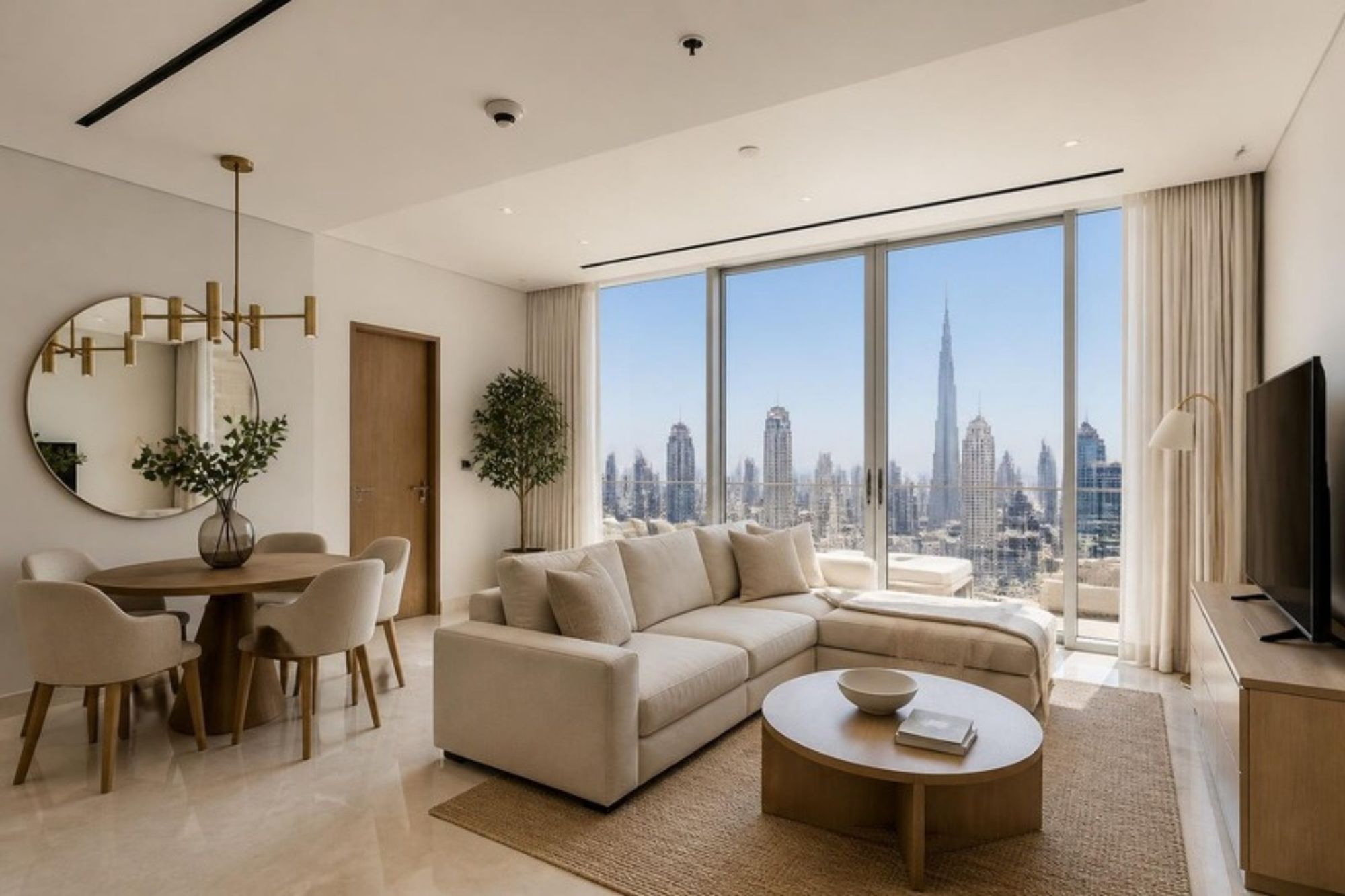


Dubai is one of the favourite markets of international property investors. That does not make every Dubai property a good investment. By 2026 the market has matured and become more selective: the outcome depends on location, the developer's track record, the payment schedule, the handover date, upcoming supply in the area, running costs and your exit plan, all together.
Why Dubai is on investors' radar
Tax is only part of the picture. Dubai has become a business, tourism and transport hub. The population keeps growing as international companies and skilled professionals arrive, which creates lasting demand for good-quality homes. Close to two hundred nationalities live in the city.
The dirham is pegged to the US dollar. That makes the currency environment more predictable, but if you think in euros or forints, it still means exchange-rate risk.
These figures come from the Dubai Land Department's Q1 2026 report, published in April 2026.
A strong market, but price growth is no longer automatic
According to a July 2026 market report by Cavendish Maxwell, around 79,200 residential transactions worth roughly AED 221bn took place in the first half of the year. That is substantial activity, but the market has moved into a more balanced, more selective phase for buyers, with a growing number of new homes being handed over.
For you as an investor, that is not necessarily bad news. In a more mature market, quality and location count for more. Weaker projects struggle to sell, while well-chosen ones stay competitive.
"Above-average capital growth is not a general promise. It is something to test project by project."
Tax: how true is the 0%?
The UAE does not levy personal income tax, and that is one of the main advantages of investing in Dubai. Things can change, however, if you run a licensed short-term rental as a business, buy through a company, or have obligations at home because of where you are tax resident.
The genuine advantage
No UAE personal income tax. A passive property investment held in your own name, structured properly, typically falls outside local corporate tax.
What needs a closer look
Licensed short-term letting, company ownership, tax residence and reporting in your home country, and the annual service charge.
Is an 8–10% yield realistic?
Rental yield is one of Dubai's strongest arguments, but always separate gross from net. A July 2026 market analysis put the average gross yield across Dubai at 6.58%.
| Property type | Average gross yield, 2026 | Typical focus |
|---|---|---|
| Apartment | approx. 6.9% | Balance of yield and liquidity |
| Townhouse | approx. 5.1% | Family demand, longer tenancies |
| Villa | approx. 4.5% | Capital preservation, own use |
| Well-chosen studio or 1-bed | 8–10% gross target | Higher yield, more management work |
Short-term letting can bring in more, but costs and effort rise too: permits, pricing, guest management, cleaning. Any projection built on high occupancy should also be run with a more cautious scenario.
We do not chase the highest gross income. We look at what is left after the service charge, management, maintenance, void months, furnishing and transaction costs.
Off-plan and paying after handover
An off-plan property is one that is still being built when you sign, or where construction has not started yet. Its main appeal is not necessarily a lower price, but that you do not pay the full amount at once: instalments are spread over the build and, on some projects, over the years after handover.
With a post-handover plan you receive the keys before you have paid the full price. Depending on the contract and the permits, you can let the property while paying the balance in instalments. This period typically runs from one to five years, and some developer offers stretch to 52 months.
Handover
You get the keys while part of the price is still outstanding.
Letting
Subject to the contract and permits, the property can start earning.
Paying on
Developer instalments fall due whatever the rental income does.
That is why we never call it a property that "pays for itself". Rent is not guaranteed, handover can be delayed, letting takes time to start, and the instalment is due even if the flat is empty.
Can you sell before handover?
This is flipping: buying early in a project and, if construction progresses and later phases are priced higher, assigning your contract to a new buyer before handover.
The terms are set by the Sales and Purchase Agreement (SPA) and the developer's policy. Resale is often only allowed once a certain share of the price has been paid, and a NOC or admin fee is charged. The threshold differs by project, so nobody can honestly promise a general 20, 30 or 40%.
The minimum paid-in share, the NOC, the fees and real buyer demand together decide whether it works. We check all of this before you reserve.
Buying safely from abroad
Dubai's property market is highly digital. For off-plan projects, reservation, identity checks, signing, payment and Oqood registration can often be done without travelling, with a passport as a non-resident. The accurate statement is this: on many projects the whole purchase can be arranged remotely.
The market is regulated by the Dubai Land Department (DLD) and RERA. Buyers' payments go into a project-specific escrow account and are released as construction progresses. That is real protection, but it does not replace due diligence.
Costs on top of the price
"No property tax" can make it sound as if there are hardly any extra costs. Not so. The DLD registration fee is, as a rule, 4% of the property's value. On a first off-plan purchase the official split is 2% seller, 2% buyer, but in practice the contract may put the whole fee on the buyer, or a developer promotion may cover it.
| Cost | What it covers | Why it matters |
|---|---|---|
| DLD registration | As a rule 4% of the value | Part of your real entry price |
| Administration | Trustee, NOC, registration and bank fees | Varies by project |
| Set-up costs | Furnishing, insurance, letting agent, utilities | Capital needed before the first rent |
| Annual running costs | Service charge, management, maintenance, voids | Directly reduce your net yield |
Dubai or Budapest?
Comparing the two markets by price per square metre makes little sense: currency, tax, tenants and financing all differ. If you are also thinking of buying in Hungary, see our guide to buying property in 2026.
| Factor | Dubai | Budapest |
|---|---|---|
| Tax | No UAE personal income tax, depends on structure | Long-term rental income taxed at 15% as a rule |
| Financing | Developer instalments, off-plan | Usually a bank mortgage, faster completion |
| Currency | AED, pegged to the dollar | Hungarian forint |
| Main advantage | International diversification, flexible payment | Local knowledge, easy hands-on control |
Project and supply risk can be higher in Dubai: some districts may see a lot of new homes arrive at once, which can hold back rents and prices.
Golden Visa. With property worth at least AED 2 million you can obtain a five-year, renewable residence visa, provided you meet the programme's conditions. No local employer is needed, and it can extend to family members.
Who it suits, and who it doesn't
It can be a good choice if you think in years, accept currency exposure and are not relying on a quick capital gain. It fits a portfolio that wants to balance part of its home-country wealth with dollar-linked property. Our investment advisory helps with the numbers, and our Dubai page covers the market in more detail.
Usually a good fit
A multi-year horizon, international diversification, accepted currency risk, enough reserves and a clear exit plan.
Usually not a good fit
If all your capital would go into a single project, if the instalments could only be paid from hoped-for rent, or if you expect a guaranteed quick resale.
"The question is not whether buying in Dubai pays in general, but whether this property, at this price and with this payment plan, meets your goal."
Figures come from 2026 market reports; before any decision we recalculate for the specific project. This article is for general information only and is not legal or tax advice.
Frequently asked questions
How much do I need to get started?
Some studios are available from a total price of very roughly EUR 155,000–180,000 (about HUF 60–70 million), but prices vary with supply, location, size and exchange rates. On off-plan projects the first instalment is 10–20% on some developments.
Can I let the property while I am still paying the developer?
With a post-handover plan, usually yes, once the property has been handed over and the necessary permits are in place. The exact rights are always set by the specific contract.
Is an 8–10% yield guaranteed?
No. Some projects or letting models can reach that gross range, but the 2026 average gross yield is about 6.58%, and about 6.9% for apartments. Net yield after costs is lower.
Can an off-plan property be sold before handover?
Often, but only on the developer's and the SPA's terms: a minimum paid-in share, a NOC and an assignment fee may apply. We check this before you buy.
Do I need to travel to Dubai?
Many off-plan purchases can be arranged without travelling, and you can register with a passport. For some completed properties, digital transfer may require an Emirates ID or UAE PASS.
How is rental income taxed?
The UAE has no personal income tax, and passive income from property held in your own name generally falls outside corporate tax. Licensed short-term operation, company ownership or your home-country tax residence can change this, which is why we also involve a tax advisor.
Thinking about buying in Dubai?
In a 30-minute call we go through your budget, ready versus off-plan, and what happens to your money at each step.
Book a Dubai call
Urbán Réka founded Monvero. She works with buyers and investors in Budapest, Dubai and on the Costa del Sol, from setting the budget to signing. This article is for general information; for advice on your own situation, get in touch.